How to Reduce Income Tax in Singapore: A Practical Guide to Tax Reliefs (YA 2025)
Last updated: March 2026 · For income earned in 2025 · Filing deadline: 18 April 2026
Most of us don’t have a tax problem. We have a tax planning problem.
Every year, many Singaporeans end up paying more tax than necessary. Not because they earn too much but because they don’t structure their reliefs properly.
This guide breaks down every personal tax relief available for YA 2026, explains when each one actually makes sense and shows you how to structure them based on your income level.
Disclaimer: This article is for educational purposes only and does not constitute financial or tax advice. Always verify your eligibility on the IRAS website or consult a qualified tax professional before making decisions.
What Is Tax Relief (And Why It Matters)
Tax relief reduces your chargeable income which is the number IRAS uses to calculate how much tax you owe. It’s not a dollar-for-dollar refund, it shifts you into a lower tax bracket.
This matters more as income increases.
At lower income levels, reliefs barely move the needle since the first $20,000 is already taxed at 0%. But at higher income levels, every dollar of relief saved is worth 11.5%, 15%, or even 22% in actual tax savings.
Over time, this compounds into meaningful savings.
The Full List of Singapore Personal Tax Reliefs (YA 2025)
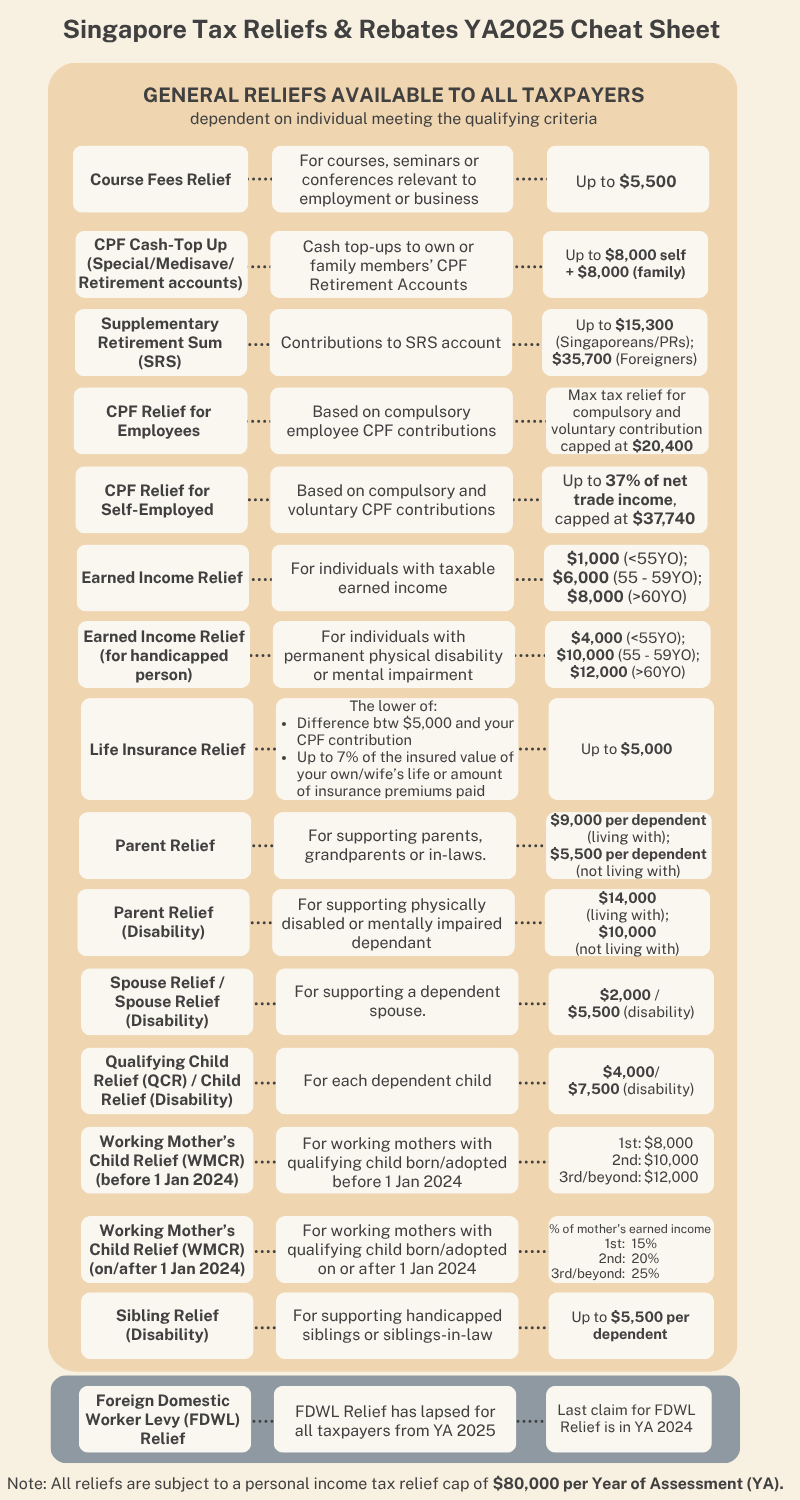
There are several personal income tax reliefs available, all subject to a combined cap of $80,000 per Year of Assessment.
To make this easier to navigate, these can be grouped into “Self & Retirement Reliefs” and “Family & Dependant Reliefs.”
Let’s walk through each one.
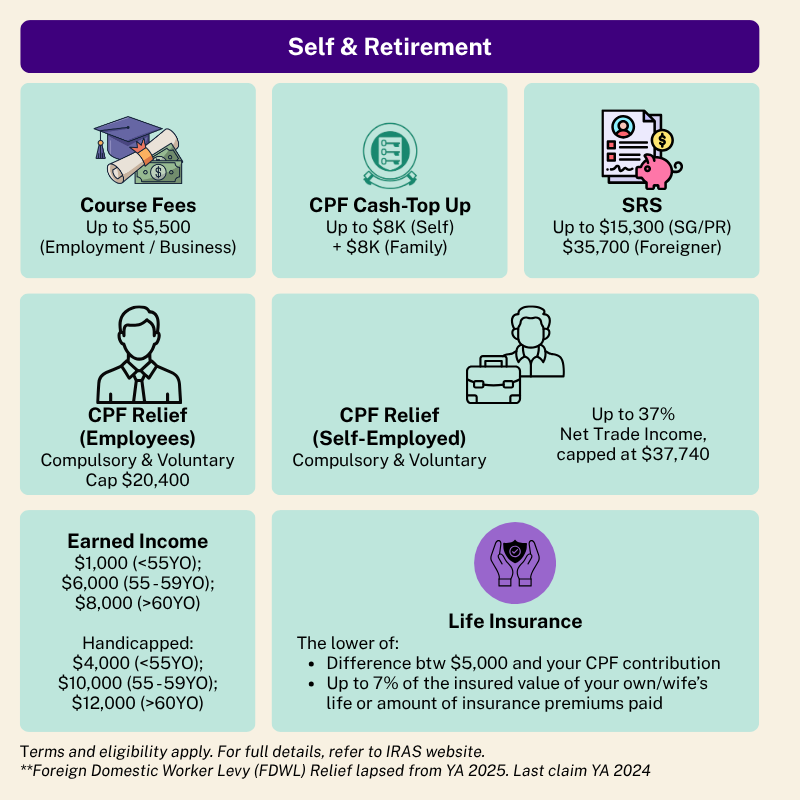
Self & Retirement Reliefs
These are the reliefs you control directly. They’re the most useful for tax planning because you can decide how much to contribute each year.
CPF Relief (Employees)
Your mandatory CPF contributions as an employee already qualify for tax relief automatically. The maximum relief for both compulsory and voluntary contributions is capped at $20,400.
You don’t need to do anything — this is pre-filled by IRAS.
CPF Relief (Self-Employed)
If you’re self-employed, your compulsory and voluntary CPF contributions qualify for relief of up to 37% of net trade income, capped at $37,740.
New for YA 2026: Self-employed persons now get tax relief on the full amount of compulsory MediSave contributions in the preceding year, without any capping restrictions, even if you have no assessable net trade income for the YA. More details here.
CPF Cash Top-Up Relief
What it is: Voluntary cash top-ups to your CPF Special Account (SA), MediSave Account (MA), or Retirement Account (RA).
Relief amount: Up to $8,000 (self) + $8,000 (family members) = $16,000 total.
When it makes sense:
- Higher income individuals looking to reduce tax efficiently
- Those comfortable locking funds into CPF for the long term
- Those who’d like to enjoy tax relief and help boost their parents’ CPF Life monthly payouts at the same time
When it may not:
- If you need liquidity in the short to medium term
- If you prefer investing externally for greater flexibility and potentially higher returns
This is one of the most popular “active” reliefs because you control the timing and amount.
Supplementary Retirement Scheme (SRS)
What it is: Voluntary contributions to your SRS account, which you can then invest.
Relief amount: Up to $15,300 (Singaporeans/PRs) or $35,700 (foreigners).
When it makes sense:
– Higher income earners in the 11.5%+ tax brackets
– Those planning for long-term retirement investments
– If you want to invest the SRS funds (stocks, bonds, ETFs, robo-advisors)
Key consideration: Funds are locked until the statutory retirement age prevailing at the time of your first SRS contribution. Early withdrawal incurs a 5% penalty, and 100% of the withdrawn amount is taxable (vs. only 50% at retirement age). So this is a long-term commitment.
Tip: Once you contribute to SRS, don’t just leave it as cash. The interest rate is negligible. Consider investing it through a brokerage or robo-advisor that supports SRS accounts.
Earned Income Relief
Automatically granted to anyone with employment or trade income:
Below 55: $1,000 (Standard) / $4,000 (Handicapped)
55 – 59: $6,000 (Standard) / $10,000 (Handicapped)
60 and above: $8,000 (Standard) / $12,000 (Handicapped)
No action needed — IRAS applies this automatically.
Course Fees Relief
Claim up to $5,500 for fees paid on courses, seminars, or conferences relevant to your current employment or an approved course of study.
This is useful for professionals pursuing certifications, MBAs, or technical courses. Keep your receipts.
Life Insurance Relief
The lower of:
- The difference between $5,000 and your CPF contribution, OR
- Up to 7% of the insured value of your own/wife’s life insurance, or the actual premiums paid
In practice, most employed Singaporeans get little from this relief because their CPF contributions already exceed $5,000. It’s more relevant for self-employed individuals or those with low CPF contributions.
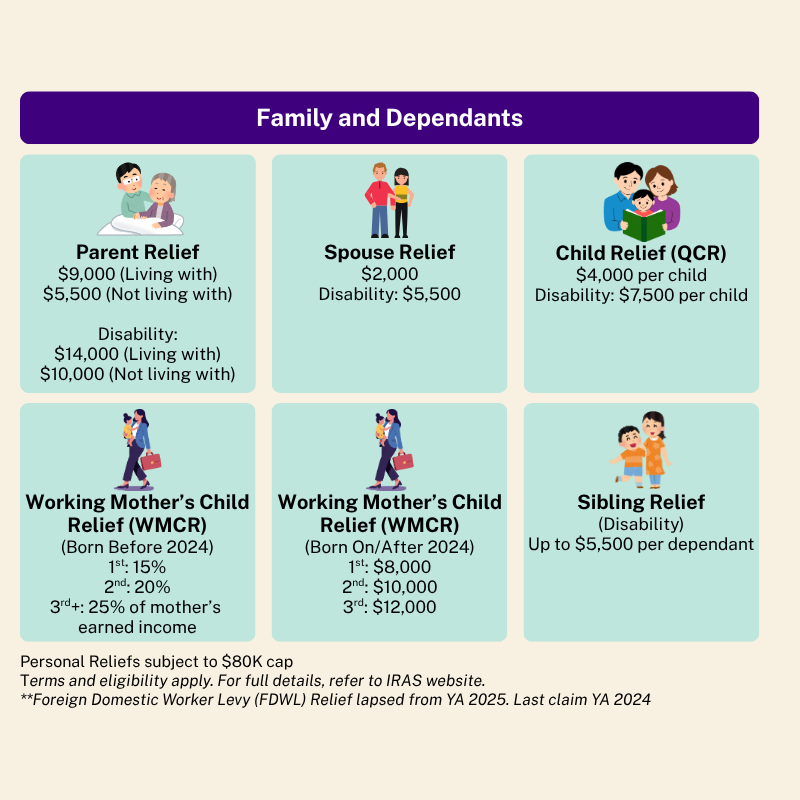
Family & Dependant Reliefs
These reliefs reward you for supporting family members. They’re “passive” in that you either qualify or you don’t so there’s less room for strategic planning.
Parent Relief / Parent Relief (Disability)
| Condition | Standard | Disability |
|---|---|---|
| Living with you | $9,000 | $14,000 |
| Not living with you | $5,500 | $10,000 |
Important: The dependant’s annual income threshold was raised from $4,000 to $8,000 starting from YA 2025. This means more parents now qualify.
Common mistake: Many people forget to claim this, especially if their parents have some CPF payouts or small side income. Check if your parents’ total income (including pensions, but excluding CPF payouts) falls below the $8,000 threshold.
Spouse Relief / Spouse Relief (Disability)
$2,000 for a dependent spouse
$5,500 for a spouse with a disability
Your spouse must have earned income of less than $4,000 in the preceding year.
Qualifying Child Relief (QCR) / Child Relief (Disability)
$4,000 per qualifying child
$7,500 per child with a disability
The child must be below 16 years old, or currently serving full-time National Service, or studying full-time at a university/educational institution. Annual income must be below $8,000 (from YA 2025).
Sibling Relief (Disability)
Up to $5,500 per handicapped sibling or sibling-in-law that you’re supporting.
Working Mother’s Child Relief (WMCR)
This one has two different schemes depending on when your child was born:
For children born/adopted before 1 January 2024:
- 1st child: 15% of mother’s earned income
- 2nd child: 20% of mother’s earned income
- 3rd child and beyond: 25% of mother’s earned income
For children born/adopted on or after 1 January 2024:
- 1st child: $8,000
- 2nd child: $10,000
- 3rd child and beyond: $12,000
The switch to fixed amounts (for post-2024 babies) makes WMCR simpler and benefits lower-income working mothers more.
Foreign Domestic Worker Levy (FDWL) Relief
This has been fully lapsed from YA 2025. The last claim was in YA 2024 and unfortunately it is no longer available.
The $80,000 Relief Cap: What It Actually Means
Personal reliefs are subject to a combined cap of $80,000 per Year of Assessment.
Here’s the thing many people misunderstand: this cap only matters if you earn significantly more than $80,000.
If your annual income is, say, $80,000, you wouldn’t want to claim $80,000 in reliefs anyway because that would reduce your chargeable income to zero, which sounds nice in theory but means you’ve locked away a large sum in CPF and SRS for minimal tax savings (since the marginal tax rate at that income level is only 7%).
The cap becomes a real constraint for higher earners — typically those earning $150,000 and above — who are stacking multiple reliefs (CPF, SRS, parent relief, child relief, WMCR) and might otherwise exceed $80,000 in total claims.
Bottom line: Don’t just chase the $80,000 cap. Instead, focus on which reliefs make sense for your specific income level and life situation.
Resident Tax Rates (From YA 2024)
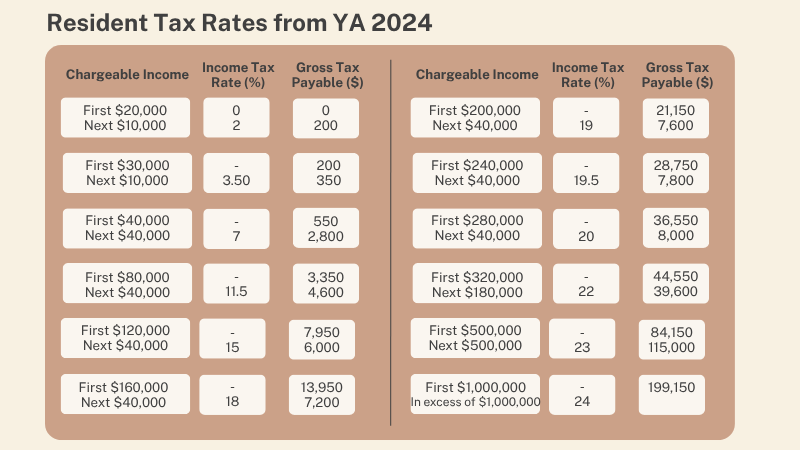
YA 2025 Bonus: There’s also a Personal Income Tax Rebate of 60% of tax payable, capped at $200, for income earned in 2024 (YA 2025). This is applied automatically and no action is needed.
When Do Tax Reliefs Actually Make Sense?
Not all reliefs are automatically worth pursuing. Always ask yourself: Am I genuinely saving tax? Or am I just locking money away unnecessarily?
Here’s a practical framework:
Lower income (below ~$40,000): Reliefs have limited impact since most of your income is already taxed at 0–3.5%. Focus on building your career and emergency fund first. Don’t lock money into SRS at this stage.
Mid income (~$80,000–$120,000): Moderate benefit. CPF top-ups start making more sense here, especially if you’re in the 7–11.5% bracket. SRS becomes worth considering. But still balance liquidity against tax savings.
Higher income ($120,000–$200,000): Strong impact. At 15–19% marginal rates, each dollar of relief saves you real money. This is where combining CPF top-ups + SRS + family reliefs becomes a strategic play.
High income ($200,000+): Maximum impact. At 19–24% rates, the tax savings are significant. This is also where the $80,000 cap actually starts to bite. Plan your relief structure carefully.
How to Structure Tax Reliefs: Practical Examples
Profile 1: Fresh Graduate / Early Career (~$50,000 income)
Tax bracket: 3.5–7%
- Your CPF employee contributions are already auto-claimed
- Earned Income Relief is automatic ($1,000)
- Consider Course Fees Relief if you’re upskilling
- Skip SRS and CPF top-ups for now, your tax savings would be minimal and liquidity matters more at this stage
Estimated tax before reliefs: ~$1,300
Practical savings from active reliefs: Limited. Focus on growing your income.
Profile 2: Mid-Career Professional (~$120,000 income)
Tax bracket: 11.5–15%
- CPF contributions auto-claimed (~$20,400 relief)
- Start considering CPF cash top-ups ($8,000 self → saves ~$920–$1,200 in tax)
- Evaluate SRS ($15,300 → saves ~$1,760–$2,295)
- Claim Parent Relief if supporting parents
- Balance liquidity vs. tax savings, don’t overcommit
Estimated tax before reliefs: ~$7,950
Potential savings from CPF top-up + SRS: $2,600–$3,500
Profile 3: Senior Professional / High Earner (~$200,000+ income)
Tax bracket: 19%+
- Max CPF top-ups ($8,000 self + $8,000 family)
- Max SRS contributions ($15,300)
- Stack family reliefs (parent, spouse, child, WMCR)
- Life insurance relief if applicable
- Watch the $80,000 cap because this is where it starts to matter
- Structure based on long-term financial plan, not just tax savings alone
Estimated tax before reliefs: ~$21,150+
Potential savings from full relief strategy: $5,000–$8,000+
Key Dates for YA 2026
- Income period: 1 Jan – 31 Dec 2025
- Tax season opens: 1 March 2026
- E-filing deadline: 18 April 2026
- Paper filing deadline: 15 April 2026
- D-NOA / Tax bills issued: From mid-March 2026
- Payment due: Within 1 month of tax bill
File at myTax Portal. If you’re on the No-Filing Service (NFS) or Direct Notice of Assessment (D-NOA), your tax bill may be issued automatically but remember to check that your relief claims are correct, especially first-time claims which are not pre-filled.
Summary: Personal Tax Reliefs at a Glance
| Relief | Max Amount | Best For |
|---|---|---|
| CPF Relief (Employee) | $20,400 | All employees (auto-claimed) |
| CPF Relief (Self-Employed) | $37,740 | Self-employed / freelancers |
| CPF Cash Top-Up | $8,000 + $8,000 (family) | Mid-to-high income, long-term planners |
| SRS | $15,300 (SG/PR) / $35,700 (foreigners) | Higher income earners |
| Course Fees | $5,500 | Professionals upskilling |
| Earned Income | $1,000–$12,000 | All earners (auto-claimed) |
| Life Insurance | Varies | Low CPF contributors |
| Parent Relief | $5,500–$14,000 | Those supporting parents |
| Spouse Relief | $2,000–$5,500 | Supporting dependent spouse |
| Child Relief (QCR) | $4,000–$7,500 per child | Families with children |
| Sibling Relief (Disability) | $5,500 | Supporting disabled siblings |
| WMCR | Varies | Working mothers |
Total relief cap: $80,000 per YA
What to Do Now
1. Check your latest Notice of Assessment at myTax Portal to see what reliefs were claimed last year
2. Identify reliefs you’re missing e.g. Parent Relief and Course Fees are the most commonly overlooked
3. Run the numbers before committing to CPF top-ups or SRS to make sure the tax savings justify the liquidity trade-off at your income level
4. File by 18 April 2026 if you need to make changes to your relief claims
Terms and eligibility apply. For full details, refer to the IRAS website.